
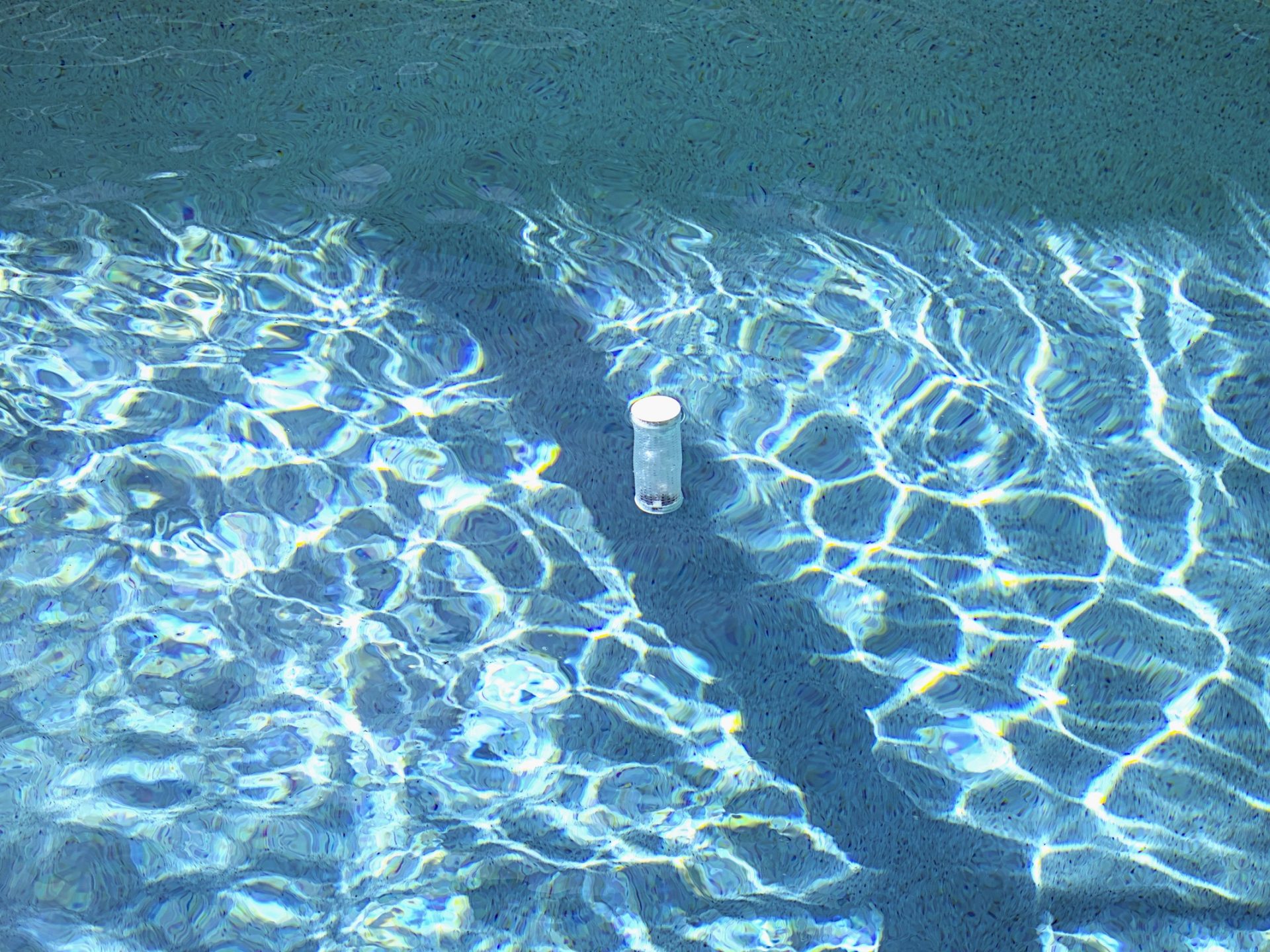
It works. I don’t know the exact science, and I’ll do my best to explain some of it below, but the biggest thing you should take away from this review is that I’ve been using the Card on Guard tube in my pool for over a month, a little longer actually, and it works.
While I have covered it before, more than once, I won’t make you read all of that to understand what’s going on.
To keep it brief, the Card on Guard tube introduces free radicals into the water of a pool or spa, created by contact with sunlight, which helps reduce the need for chlorine. Why? The idea is so you can lower the chlorine concentration in the water so it’s less harsh on your body, skin and hair. Most importantly, the Card on Guard tube still fends off nasty bacteria and mold so the pool stays clear, fresh and soothing. You can take a refreshing dip in water that’s not laden with chemicals, or smelling or feeling that way.
Proprietary BioPhotonX UV light conversion technology embedded in the Card on Guard tube captures and magnifies UV light. That helps it break down portions of water molecules, which reform into free radicals — those attack, weaken and inhibit the reproduction of bacteria in the water. According to third-party research, UV photons generate oxidative free radicals after interacting with certain molecules. “Free radicals avidly attack macromolecules such as proteins, lipids, RNA and DNA, altering their structure and interfering with their function.” In other words, it tracks. But as far as I’m aware, the free radicals in the water aren’t interacting or attacking any human DNA.
The Card on Guard tube and solar sanitizer is compatible with both standard chlorine and saltwater pools. My pool is saltwater, so that’s how I’ll be approaching this review.
Let’s spray on some sunblock and hit the deck without wasting any time. Grab yourself a drink and a snack, and we’re off.
How does it work?
 Source: Briley Kenney / Techigar
 Source: Briley Kenney / Techigar
 Source: Briley Kenney / Techigar
After unwrapping the tube, you drop it in the water, and that’s it. You can either let it float freely in the pool or place it in the skimmer out of view. I just tossed ours into the deep end. Call it a placebo, but within the hour the pool already looked clearer and cleaner — my wife commented the same.
After the tube is in the pool, you lower the chlorine concentration on a weekly basis. You can do this from the salt cell controller; the salt cell converts salt into chlorine in a saltwater pool. Before you drop in the tube, you’re supposed to measure the salt (ppm) and pH balance. I do that daily, so I didn’t feel the need to do it separately.
With a test kit, you must confirm the water pH is between 7.2 and 7.6 with an alkalinity level of 80 to 120. Free chlorine must be between 1 to 2 ppm with a total hardness of 180 to 220 and a cyanuric acid concentration of 30 to 50.
After a week, you check the levels to make sure they’re maintained — actually, you check them every time you adjust. If they’re holding steady, you reduce the chlorine production levels at the salt cell, or if you have a freshwater pool or spa, you simply reduce how much chlorine you’re adding to the water. Your reduction pattern should be down to 75% chlorine after a week, 60% after two weeks and 45% after three weeks.
Even after reducing the production, chlorine levels should stay around 1 to 2 ppm if everything is working correctly.
How important is it to maintain the correct levels?
 Source: Briley Kenney / Techigar
 Source: Briley Kenney / Techigar
Maintaining the appropriate chlorine and pH levels in a pool or spa will always be important, no matter where you live. But in certain places, like hot, humid and sunny Florida, where I live, a misstep can create a lot of problems. The sun constantly beats down on the water in our pool, and as you may know, regular sunlight is a recipe for mold and mildew.
Since the sun is focused on our pool all day, every day, it can make things troubling at times. The way our property is situated the sun rises on one side and travels to the other side as it sets, completely covering the back of our home, patio, and pool all day long. Our salt cell was having issues a while back and immediately — I’m talking like instantly — you could notice a difference. The water was greener, not as fresh, and there were mold spots appearing at the bottom. Having it replaced cleared that right up, along with pouring in some algaecide, but the important point is that it shows how fast things can go wrong with levels that aren’t maintained well. We’re talking hours and days, not weeks. It happens fast.
Understandably, I was a bit concerned about trying the Card on Guard, because I was uneasy about lowering the chlorine concentration in our saltwater pool. While I was right to be concerned, the tube has put my mind at ease.
Eureka!
 Source: Briley Kenney / Techigar
The pool is clean. The levels have stayed where they should be, and there’s a lot less maintenance required overall. For example, it has rained almost every day over the past month or so. Usually, that would mean checking the levels regularly, putting in salt, maybe some algaecide and other chemicals. That’s because the rain tends to dilute the water when there’s a lot, and the pH of Florida’s rain tends to be pretty high. It can throw the levels out of whack. The Card on Guard tube has definitely helped to keep things more balanced.
If you’re a numbers person, my pool’s pH stays around 7.5 to 7.6, with a higher alkalinity around 110 or so. It also sits pretty darn close to the 2 ppm chlorine concentration mark. My salt cell is currently set to produce about 40% chlorine.
Towards the end of the review period, I slowed down my regular level checks. It wasn’t necessary to check every day by that point. Plus, it was a welcome change, since I reclaimed some personal time.
It doesn’t completely eliminate maintenance
 Source: Briley Kenney / Techigar
 Source: Briley Kenney / Techigar
 Source: Briley Kenney / Techigar
I think it’s important to taper expectations and outline some limitations. While the Card on Guard tube does balance chemical and chlorine levels, and certainly removes a lot of the extra maintenance you’d have to do, it doesn’t eliminate everything. By that, I mean, you still have to monitor and check the chlorine and pH levels, and if it’s a saltwater pool like mine, you have to check the salt levels. You still have to clean your pool, including vacuuming the bottom. You should still scrub the tile and make sure no nasty residues build up.
Basically, everything that you’d have to do normally to maintain your pool or spa still needs to be administered. What the Card on Guard does is essentially allow you to lower the chlorine concentration for an improved experience, while reducing some of the minutiae of pool care. You won’t need to add as much chlorine or salt. And if the levels remain balanced, you don’t have to add extra chemicals like shock or acid.
In my case, I still need to clean out the pump filter monthly. I also need to clean the salt cell — with acid. Provided the salt levels stay balanced, I don’t have to add salt unless they dip below a certain threshold. It’s all fairly standard stuff, really.
What’s the verdict, and the price?


Normally, when you jump into or swim in a saltwater pool, you come out with a very thin but noticeable film on your skin. It’s a little like swimming in the ocean and its saltwater, although not quite as prevalent. So basically, you can feel the salt on your skin and in your hair. It’s not an unpleasant feeling. I’m sure many of you know it too. But it is there. Because I am able to lower the salt and chlorine concentration in my pool, that feeling is gone. Not without sacrificing water quality, however, which is a net positive. It’s also a lot less harsh on the eyes, which doesn’t have much of an effect on me, but certainly makes my kids happy.
They are like fish, jumping, diving, swimming, all underwater, with goggles and without, but usually with their eyes wide open. If and when the levels are higher, that can cause their eyes to dry out and burn — an experience anyone who swims in a chemical-filled public pool knows all too well. The Card on Guard tube helps reduce that issue significantly. I can accurately report that to be true, as promised, and also share that it works well.
What about the price?
 Source: Briley Kenney / Techigar
 Source: Briley Kenney / Techigar
Outside of that, in regard to maintenance, the cost alone is worth it. If we do the math, a two-pack of Card on Guard tubes is $68. Meanwhile, a single 40-pound bag of pool salt is about $8 at the cheapest. I buy, on average, about five or six bags of salt per year. That’s about $48 for just the salt alone (6 x $8). The estimate doesn’t include any maintenance or parts for the pump, any other chemicals I use like shock or algaecide, or even the time required to clean the pool — like scrubbing residues off the tile.
That’s a small price to pay for cutting down on a lot of maintenance, including costs, and time saved. Something unique to note here is that Florida is a near-tropical climate and we get rain almost every day, late in the afternoon, especially during the spring and summer seasons. Rain can mess with the pH and chlorine levels in high amounts. If you live somewhere, there’s not much rain, that might be of no concern to your pool care regimen.
A single tube covers about 10,000 gallons. If you have a large pool, it might be a bit more expensive. However, in my pool, which is roughly 7,000 gallons, one tube lasts for about six months, while two last for a whole year. Chemical expenses or not, about $68 per year to keep my pool clean, clear and refreshing is okay with me. There’s also a Card on Guard Fin which works like the tube.
- Recommended Buy: Unequivocally yes.
- For Who: All pool and spa owners, saltwater or otherwise.
- Alternative: Card on Guard Solar Sanitizer FIN
- MSRP: $68 for a 2-pack


